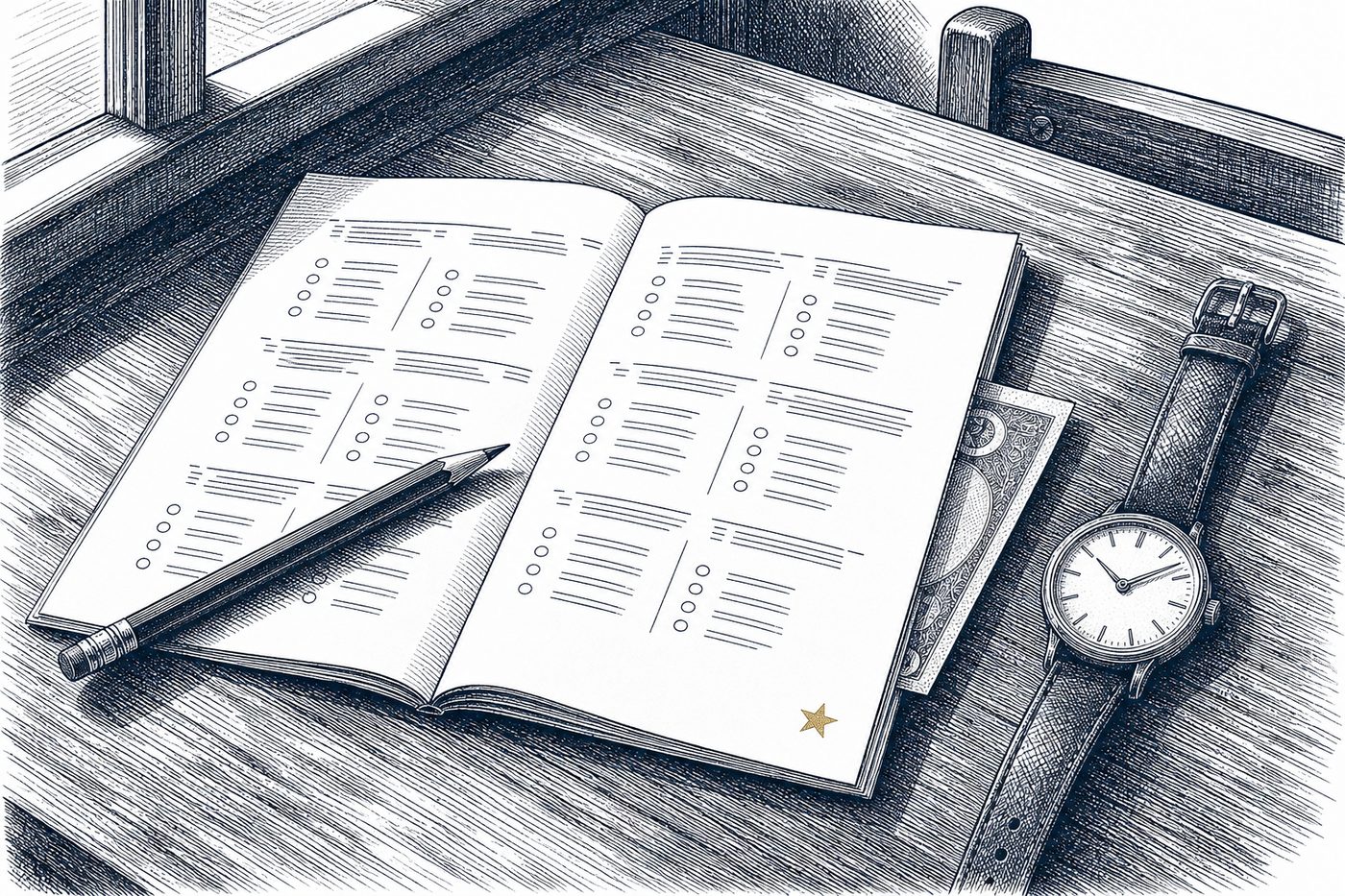
A single thirty-minute assessment, adapted from a global benchmark and rewritten for a sixteen-year-old in Pune or Mumbai. Every result is read against the board a student sits under and the household they come from.
The benchmark
The core is adapted from the S&P Global Financial Literacy Survey — 150,000 adults, 140 countries, four tested ideas: numeracy, compound interest, inflation, and spreading risk. Measuring the same four ideas means our results can be read against a standard the world already recognises.
But the original questions were written for adults of every reading level worldwide, so they stay abstract. We keep each idea at the same difficulty and rebuild it as a situation from a student's own life.
The same question, rebuilt
S&P original
Suppose you have some money. Is it safer to put your money into one business or investment, or to put your money into multiple businesses or investments?
Skyward rephrasing
Ved saves ₹6,000 over a year from Diwali money and tuition savings. His cousin says one small company's shares rose 50% last year and that he should put all ₹6,000 into it to “double his money.” His classmate says he should split the money across a few different places instead. Which approach carries less risk of Ved losing a large part of his savings, and why?
Same idea, same difficulty. But the student is no longer naming a principle in the abstract — and the wrong answer is the exact temptation the idea guards against.
The paper
Thirty minutes. Twenty-five marks. Scenario-based multiple choice throughout, with every wrong option carrying a common money mistake. The difficulty climbs across four tiers.
-
I · Foundation
Wants versus needs, budgeting, savings accounts, spotting an obvious scam.
-
II · Developing
Simple versus compound interest, digital fraud, emergency funds, opportunity cost.
-
III · Proficient
Inflation and purchasing power, comparing savings products, diversification, insurance.
-
IV · Advanced
The true cost of a loan, “no-cost EMI” traps, inflation-adjusted planning, tax-aware choices.
Why one paper
If students sat different papers, or were marked to different standards, any difference we found could come from the test rather than the students. One paper, one fixed answer key, three languages — English, Hindi and Marathi, each back-translated to hold the meaning.
Background, anonymously
A short cover page carries no name, only an ID code: parental education and a handful of household details, forming a Kuppuswamy-based socioeconomic index. It is what lets us read every result in context without collecting anything identifying.
What the results tell us
Each student gets a score and the highest tier they reliably reach, placing everyone on one common scale. Because the paper never changes, a Grade 9 group in one kind of school can be compared straight across with a Grade 12 group in another. That comparison is the whole point.
No school is ever named or ranked. Schools interested in hosting a pilot can get in touch.
Sit it yourself
Grades 9 to 12. Twenty-seven questions. Results by email about an hour after you finish. Take the test.